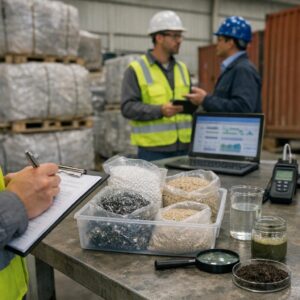
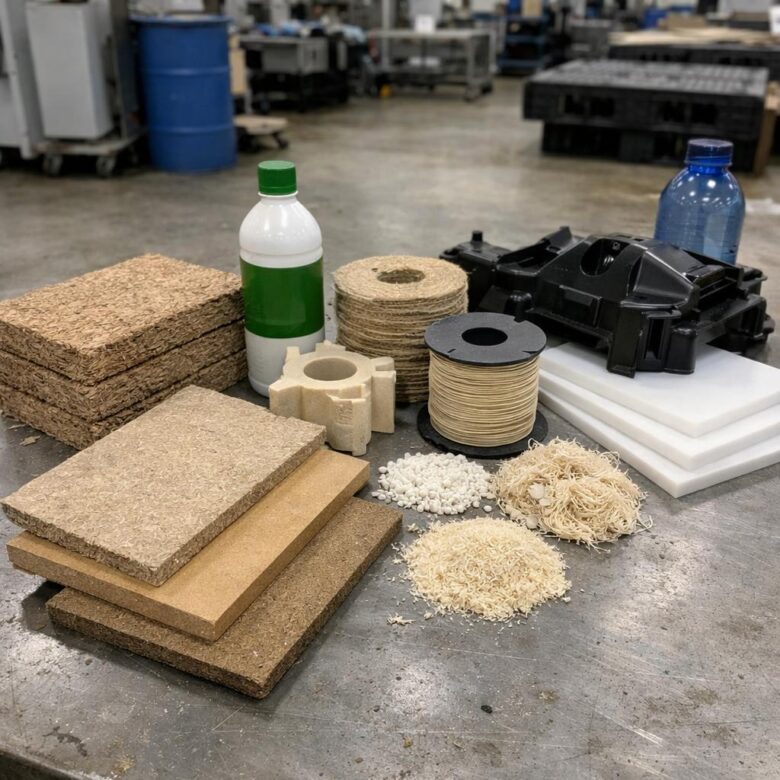
Replacing an industrial plastic is not a matter of choosing the material with the greenest label. The substitute must preserve safety, durability, manufacturability, compliance, and product life while delivering a measurable environmental improvement.
High-impact plastics are used across packaging, automotive components, electrical housings, industrial equipment, logistics products, construction materials, and consumer goods because they can combine low weight, impact resistance, moisture protection, chemical stability, insulation, and efficient high-volume processing.
That combination is difficult to replace with a single universal material. A recycled polymer may be the best option for a pallet, molded fiber may suit a protective insert, a natural-fiber composite may work for an interior panel, and metal may make sense for a reusable container expected to remain in service for many years.
The phrase “high-impact industrial plastic” also covers many different applications rather than one specific polymer family. ABS, polycarbonate, polypropylene, polyethylene, nylon, PET, PVC, polyurethane, and reinforced engineering plastics have very different properties. A credible substitution process must therefore begin with the exact grade, function, and operating environment of the current part.
Core principle: the most sustainable option is not always a different material. Reducing unnecessary mass, extending product life, designing for repair, creating a reuse system, or simplifying a multi-material product can deliver a stronger result than a direct one-for-one replacement.
Start With the Function, Not the Material Label
A plastic part is normally chosen because it performs several jobs at the same time. A machine guard may need impact resistance, transparency, dimensional stability, flame performance, and compatibility with cleaning chemicals. A shipping crate may need repeated impact resistance, stack strength, low weight, and repairability.
Before considering alternatives, create a performance map that defines what the existing material must survive.
- Mechanical load, shock, vibration, fatigue, and abrasion
- Operating and storage temperature range
- Exposure to water, humidity, UV radiation, oils, or solvents
- Flammability, smoke, and electrical insulation requirements
- Food-contact, medical, automotive, or other regulatory obligations
- Expected service life and maintenance conditions
- Injection molding, extrusion, thermoforming, bonding, or welding needs
- End-of-life collection and recovery options in the actual market
A weaker substitute may create more waste. If the new material cracks earlier, requires thicker walls, produces more scrap, increases product returns, or shortens service life, its total impact may be worse even when its feedstock appears more sustainable.
A Better Order for Material Decisions
Sustainable material management is strongest when the business considers prevention and circular design before assuming that a different disposable material is the only answer.
Best Substitute Categories to Evaluate
Recycled-Content Plastics
Recycled PET, HDPE, polypropylene, ABS, polycarbonate blends, and other recovered polymers can reduce demand for virgin resin while preserving familiar molding or extrusion processes.
They are frequently evaluated for pallets, crates, bins, panels, cable reels, drainage products, protective components, furniture, and selected non-critical housings.
Main caution: contamination, degradation, color variation, odor, melt-flow variation, and inconsistent mechanical properties must be controlled.
Bio-Based Drop-In Plastics
Some bio-based polyethylene and PET grades can be chemically equivalent to conventional fossil-derived versions. This may allow existing production and recycling routes to remain usable, subject to local acceptance and the exact material specification.
Main caution: bio-based does not mean biodegradable, compostable, or automatically lower-impact across the full life cycle.
PLA, PHA, and Compostable Polymers
These materials may be useful in selected films, service items, coatings, packaging, and applications connected to a defined organic-waste collection system.
Main caution: heat resistance, impact strength, moisture behavior, shelf life, recycling contamination, certification, and access to appropriate composting infrastructure must be verified.
Natural-Fiber Composites
Wood flour, cellulose, flax, hemp, jute, kenaf, bamboo, or agricultural fibers can be combined with a polymer matrix to reduce virgin resin use and improve stiffness or appearance.
Main caution: moisture absorption, dimensional movement, fire performance, odor, UV aging, biological growth, and recycling compatibility require careful testing.
Molded Fiber and Paper-Based Systems
Molded pulp, corrugated structures, paper honeycomb, and fiber-based inserts can replace some plastic foams, trays, cushioning systems, and secondary packaging.
Main caution: coatings, laminates, adhesives, wet strength, grease barriers, and moisture protection may reduce recyclability.
Metal and Glass
Aluminum, steel, stainless steel, and glass can work well where repeated reuse, high heat resistance, chemical resistance, repairability, or a long service life justifies their weight and production requirements.
Main caution: a heavy single-use substitute can increase transport burdens and may not outperform a lightweight durable plastic.
Quick Comparison of the Main Alternatives
| Substitute Route | Promising Applications | Potential Benefit | Critical Question |
|---|---|---|---|
| Recycled version of the same polymer | Pallets, crates, bins, packaging, panels, and selected molded parts | Lower virgin resin use | Can the supplier control contamination and batch variation? |
| Bio-based drop-in resin | Applications where familiar processing and recycling compatibility matter | Renewable feedstock share | Is the claimed bio-based content documented and traceable? |
| Certified compostable polymer | Selected items connected to a controlled organic-waste system | Organic recovery option | Will the product actually reach an accepting industrial facility? |
| Natural-fiber composite | Interior panels, furniture, casings, decking, and semi-structural components | Reduced polymer content | How will moisture, heat, fire, and aging affect the part? |
| Molded fiber or paper structure | Protective packaging, inserts, trays, dividers, and dry-product systems | Simpler fiber recovery | Do coatings or barriers prevent practical recycling? |
| Metal or glass | Reusable containers, durable housings, high-temperature and chemical applications | Long life and reuse | How many reuse cycles are needed to justify added weight and energy? |
| Product redesign | Nearly any product with excess mass, unnecessary layers, or poor repairability | Material prevention | Can the same function be delivered with less material? |
Recycled Plastics: Practical, but Not Risk-Free
Recycled-content plastics are often the least disruptive starting point because they may be processed with familiar equipment and can preserve many of the advantages that made plastic attractive in the first place.
Post-industrial recycled material generally comes from controlled manufacturing scrap, while post-consumer recycled material comes from products that have completed a use cycle and entered a collection system. The two streams can have different levels of traceability, contamination, color variation, and property consistency.
For an industrial buyer, the recycled-content percentage is only one part of the specification. The supplier should also explain the resin source, sorting method, contamination controls, additive package, property tolerances, and batch-testing process.
A gradual qualification path can reduce risk. Some manufacturers begin with a controlled blend of virgin and recycled material, complete production and field testing, and then increase the recycled percentage when performance remains stable.
What to Request From the Supplier
- Exact polymer type and grade designation
- Post-consumer and post-industrial content percentages
- Technical and safety data sheets
- Melt-flow or rheology control data
- Impact, tensile, flexural, and thermal properties
- Contamination and restricted-substance controls
- Batch-to-batch tolerance information
- Documentation supporting environmental claims
Bio-Based, Biodegradable, Compostable, and Recyclable Are Different
These terms are often used together in marketing, but they describe different characteristics. Confusing them can lead to incorrect disposal instructions, contaminated recycling streams, and environmental claims that are difficult to support.
Industrial compostability is not the same as home compostability or environmental disappearance. Standards for industrially compostable plastics assume controlled conditions such as managed temperature, moisture, aeration, and processing time.
Before selecting a compostable product, confirm that the exact finished item—not only the base resin—has appropriate certification. Printing inks, labels, adhesives, thickness, fillers, and coatings can change how the final product behaves.
Natural-Fiber Composites Need Real Aging Tests
Natural-fiber composites can reduce the quantity of fossil-based polymer in a component and may provide useful stiffness at a relatively low weight. They are frequently considered for interior panels, decorative parts, furniture, decking, trays, casings, and semi-structural components.
The environmental case depends on more than the fiber percentage. The matrix polymer, coupling agents, pigments, fire retardants, stabilizers, coatings, production scrap, and final recovery route all influence the result.
Moisture is one of the most important engineering issues. Some fibers absorb water and can swell, alter dimensions, weaken interfaces, or change appearance. Accelerated humidity, thermal cycling, UV exposure, and biological-growth testing may therefore be necessary for outdoor or wet applications.
Do not compare stiffness alone. A composite may appear strong in a standard tensile test but behave differently under impact, repeated loading, notches, cold temperatures, or long-term moisture exposure.
When Paper, Molded Fiber, Metal, or Glass May Be Better
Non-plastic alternatives are most convincing when their physical properties and recovery system match the application. Molded fiber can work well for protective packaging and inserts that do not face prolonged moisture. Metal and glass can be effective in reusable systems where many cycles spread the production impact over a long service life.
Problems arise when a substitution focuses only on the visible material. A paper package may require a difficult-to-separate coating. A glass container may break more often or add transport weight. A metal component may need more forming energy and become excessive for a short-lived product.
For reusable containers, compare the complete operating system: collection, return distance, washing, drying, loss rate, maintenance, and the number of successful reuse cycles.
Application-Based Selection Guide
| Application | Options Worth Screening | Tests That Matter Most |
|---|---|---|
| Reusable logistics pallet or crate | Recycled HDPE or PP, repairable design, pooled reuse system | Drop, stack, fork impact, temperature, fatigue, and dimensional stability |
| Protective shipping insert | Molded fiber, corrugated structure, recycled polymer foam, reusable cushioning | Vibration, shock, compression, humidity, and product-damage rate |
| Machine guard or electrical enclosure | Qualified recycled engineering plastic, metal, or carefully specified composite | Impact, flame, electrical, heat, chemical, and applicable certification tests |
| Automotive interior panel | Natural-fiber composite, recycled PP blend, mono-material redesign | Odor, emissions, heat aging, UV, impact, fire, and dimensional stability |
| Single-use dry-goods tray | Molded fiber, lightweight recycled plastic, certified compostable design where collection exists | Moisture, grease, compression, sealing, and realistic end-of-life acceptance |
| Reusable chemical container | Compatible polymer, stainless steel, coated metal, or glass in selected cases | Chemical compatibility, pressure, impact, cleaning, seals, and transport safety |
A Nine-Step Qualification Process
-
Identify the current material precisely.
Record the polymer, grade, reinforcement, additives, thickness, part weight, supplier, manufacturing method, and reason it was originally selected. -
Define non-negotiable performance requirements.
Separate mandatory safety and regulatory properties from desirable appearance, cost, and processing characteristics. -
Set the environmental objective.
Decide whether the project is intended to reduce virgin feedstock, total mass, carbon impact, hazardous substances, landfill, or product replacement frequency. -
Screen several realistic pathways.
Compare reduction, reuse, recycled content, bio-based drop-in materials, natural-fiber composites, fiber packaging, metal, glass, and product redesign. -
Verify the real end-of-life route.
Contact recyclers, composters, take-back operators, or customers to confirm what is actually collected and processed in the intended market. -
Review supplier evidence.
Collect data sheets, certificates, test reports, declarations, traceability records, restricted-substance information, and claim-support documentation. -
Run laboratory and pilot-production tests.
Examine strength, impact, heat, chemicals, aging, processing temperature, cycle time, tooling behavior, surface finish, bonding, and scrap rate. -
Complete limited field validation.
Use controlled batches to observe transport damage, cleaning behavior, odor, warping, complaints, repairability, and long-term exposure. -
Scale gradually and monitor variation.
Track defect rates, production stability, supplier reliability, customer feedback, recovery performance, and whether the environmental objective is being achieved.
Compare the Complete Life Cycle and Total Cost
Material price alone does not show whether a substitute is financially or environmentally preferable. A meaningful comparison should include manufacturing, transport, service life, failure, maintenance, recovery, and disposal.
For a high-volume or strategically important change, a life cycle assessment can provide a more structured comparison. The study should use a clear functional unit—for example, delivering a defined number of protected shipments rather than comparing one kilogram of each material without considering performance.
Compare equal function. A lighter material that fails after one use should not be compared directly with a heavier option that completes hundreds of reuse cycles without accounting for those differences.
Avoiding Greenwashing and Weak Environmental Claims
Terms such as “green,” “eco-friendly,” “planet safe,” and “sustainable” are too broad when they are not supported by a clear explanation. A credible claim should identify the exact attribute, measurement boundary, percentage, test method, and limitation.
Weak claim: “Made from eco-friendly plastic.”
Stronger claim: “The housing contains 40% post-consumer recycled polypropylene by weight, based on supplier documentation. The claim applies to the housing only and does not include fasteners or electronic components.”
Evidence Should Match the Claim
- State whether recycled content is post-consumer or post-industrial
- Identify whether a percentage applies to one part or the complete product
- Name the composting standard and required facility conditions
- Explain whether “recyclable” depends on local collection availability
- Avoid implying that bio-based material is automatically biodegradable
- Keep certificates and supplier evidence available for review
- Update claims when material composition or suppliers change
- Do not hide performance, disposal, or infrastructure limitations
Common Substitution Mistakes
| Mistake | Possible Consequence | Better Approach |
|---|---|---|
| Choosing by marketing language alone | The material fails technically or the environmental benefit cannot be proven | Require measurable specifications and supporting evidence |
| Ignoring product lifespan | More replacements, returns, waste, and operating cost | Compare durability and use cycles, not only feedstock origin |
| Assuming theoretical recyclability is enough | The product still goes to landfill or contaminates another stream | Verify local collection, sorting, and processing |
| Replacing lightweight plastic with heavy single-use material | Higher transport burden and handling problems | Evaluate the full logistics system and potential for reuse |
| Skipping production trials | Longer cycle times, tooling issues, high scrap, and inconsistent quality | Run pilot batches on real equipment before scaling |
| Using compostable material without collection infrastructure | Incorrect disposal, contamination, or no practical recovery benefit | Match the material to an established and accepting system |
| Ignoring additives and coatings | The finished product behaves differently from the base material | Evaluate and certify the complete finished item |
When Professional Review Is Essential
A qualified materials engineer, polymer specialist, laboratory, certification body, or regulatory professional should be involved when the part performs a safety-critical, structural, electrical, medical, food-contact, automotive, aerospace, pressure-containing, or chemical-containment function.
These applications may require standardized mechanical tests, thermal analysis, flame testing, electrical testing, migration studies, chemical compatibility, accelerated aging, traceability, and regulatory approval. An apparently minor resin change can affect certification, tooling, dimensions, joining methods, warranty terms, and product liability.
Do not rely only on a supplier’s general brochure. Verify that test reports and certifications apply to the exact grade, formulation, thickness, color, additive package, and manufacturing process planned for the finished product.
Practical Recommendation for Industrial Buyers
Begin with low-risk applications where the material is non-structural, easy to inspect, and already supported by established recycled or fiber-based supply chains. Secondary packaging, protective inserts, bins, pallets, interior panels, and selected non-critical components can provide useful starting points.
More demanding substitutions should follow a controlled engineering process. The best-performing programs usually combine product redesign, qualified recycled content, supplier traceability, realistic end-of-life planning, pilot production, and long-term monitoring.
A sustainable substitute is successful when it performs its required function, lasts long enough, fits available recovery systems, avoids unnecessary material, and supports specific environmental claims with reliable evidence.
Frequently Asked Questions
What is usually the easiest industrial plastic substitution?
A qualified recycled-content version of the same polymer can be one of the least disruptive options because it may preserve familiar processing and product design. It still requires testing for contamination, mechanical properties, processing stability, appearance, and batch consistency.
Are bio-based plastics always more sustainable?
No. Their performance depends on feedstock production, energy use, durability, additives, transport, manufacturing, recycling compatibility, and end-of-life management. A life cycle comparison is more reliable than judging the material from its feedstock alone.
Does biodegradable plastic break down anywhere?
No. Biological breakdown depends on conditions such as temperature, moisture, oxygen, microorganisms, product thickness, and time. A material designed for industrial composting should not be assumed to break down in soil, water, home compost, or landfill.
Can recycled plastic be used in demanding products?
It can be used in many applications when the grade is properly specified and qualified. Safety-critical, structural, food-contact, medical, electrical, or highly regulated products may require tighter traceability, additional testing, and specific approvals.
When is metal a better replacement for plastic?
Metal may be preferable where heat resistance, structural strength, repairability, chemical resistance, or repeated reuse is important. Its higher weight and production requirements should be balanced against the expected service life and recovery value.
What should be tested before full-scale conversion?
Testing may include impact, tensile and flexural properties, heat deflection, thermal cycling, moisture, UV aging, chemicals, flame behavior, dimensional stability, bonding, welding, printing, tooling behavior, cycle time, scrap, and limited field use.
Is recyclable the same as recycled?
No. Recycled means the product contains recovered material. Recyclable means the product can potentially be collected and processed into another useful material. A product may contain recycled content but still be difficult to recycle again.
Official References and Further Reading
- U.S. Environmental Protection Agency — Sustainable Materials Management Basics
- National Institute of Standards and Technology — Circular Economy Program
- United Nations Environment Programme — Turning off the Tap
- OECD — Plastics and the Circular Economy
- ISO 17088:2021 — Specifications for Compostable Plastics
- ISO 14040 — Life Cycle Assessment Principles and Framework
- ISO 14044 — Life Cycle Assessment Requirements and Guidelines
- U.S. Federal Trade Commission — Environmental Claims and Green Guides

The Ogumex Editorial Team creates practical, research-based content about commercial solar energy, battery storage, clean technologies, and sustainable industrial solutions. Our goal is to explain complex topics clearly, helping professionals, businesses, and informed readers make better decisions. Each article is reviewed for clarity, accuracy, and usefulness using reliable industry and official sources.