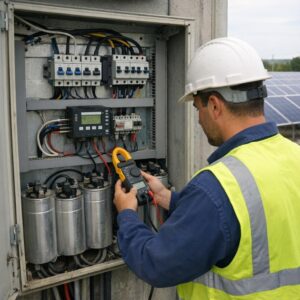
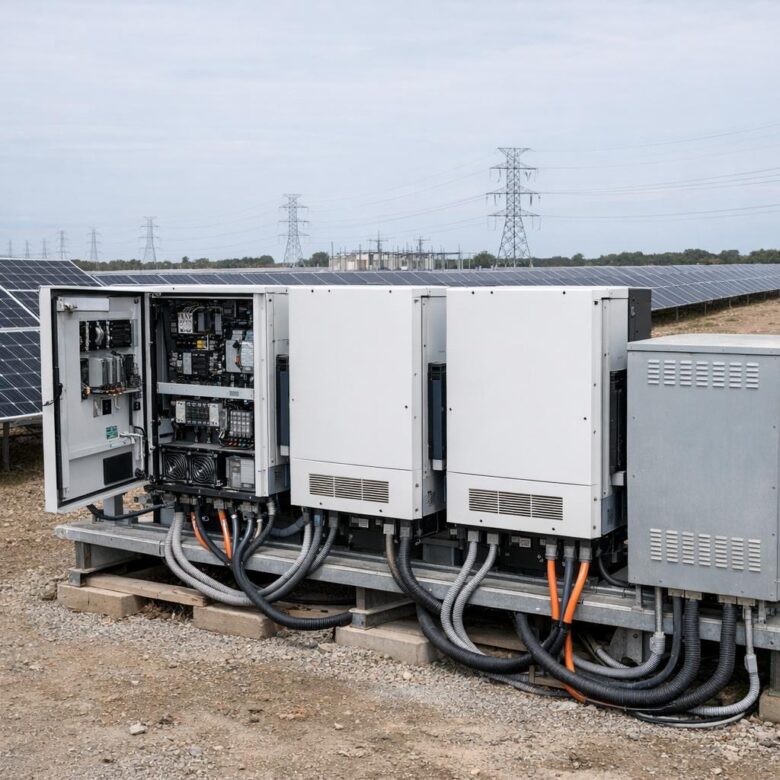
The best inverter technologies for grid-scale commercial solar projects are not chosen only by price, brand, or peak efficiency. A good inverter choice must match the plant size, grid connection requirements, climate, maintenance strategy, monitoring needs, and the utility’s interconnection rules.
For large commercial and utility-scale solar plants, the inverter is more than a device that converts DC power from solar modules into AC power for the grid. It also affects energy yield, grid stability, fault response, reactive power control, cybersecurity, downtime, and long-term operating cost.
A central inverter may look attractive for a very large site because it can simplify the power block design. A string inverter may be better when the site has uneven terrain, multiple roof sections, shading differences, or a need for more granular monitoring. Hybrid and grid-forming inverter options become important when the project includes battery storage or connects to a weak grid.
The safest way to choose is to compare inverter technologies against the actual project conditions, not against generic marketing claims. In practice, many poor inverter decisions happen because the design team focuses on nameplate capacity and ignores grid code compliance, spare parts access, thermal behavior, or firmware management.
This guide explains the main inverter technologies, where each one fits, what to check before procurement, and which mistakes can create expensive problems after commissioning.
Important note: grid-scale solar inverter selection should be validated by qualified electrical engineers, interconnection specialists, and the relevant utility or grid operator. High-voltage equipment, protection settings, and grid compliance requirements can create safety and reliability risks if they are handled without professional review.
How the Best Inverter Technologies for Grid-Scale Commercial Solar Projects Differ
Large solar projects usually use one of three main inverter approaches: central inverters, commercial string inverters, or hybrid inverters connected to battery energy storage. In more advanced projects, the discussion may also include grid-support and grid-forming inverter functions.
The basic difference is how the system converts power and how much control the project owner has at each part of the solar field. Central inverters convert power from large groups of modules at a central location. String inverters convert power from smaller groups of modules. Hybrid inverters can manage solar generation and battery storage through a coordinated power conversion system.
For a flat, uniform, ground-mounted solar plant with simple access roads and predictable production, central inverters can still be a strong option. For commercial rooftops, distributed ground sites, hilly land, or projects with multiple orientations, string inverters often provide better design flexibility and more detailed fault detection.
The best technology is the one that keeps production stable while meeting the project’s electrical, financial, and operational limits. A low-cost inverter that causes frequent trips, requires difficult service access, or fails to meet utility requirements can become more expensive than a higher-quality option.
| Inverter technology | Best use case | Main caution |
|---|---|---|
| Central inverter | Large, uniform ground-mounted solar plants with simple power block design. | A single failure can affect a large section of plant output. |
| Commercial string inverter | Distributed sites, uneven layouts, rooftops, carports, and projects that need granular monitoring. | More units mean more devices to manage, inspect, and replace. |
| Hybrid inverter | Solar-plus-storage projects that need battery charging, dispatch, and backup-related functions. | Control coordination with the battery system must be carefully engineered. |
| Grid-support smart inverter | Projects that must provide voltage, frequency, reactive power, and ride-through functions. | Settings must match utility requirements and should not be left at generic defaults. |
| Grid-forming inverter | Weak grids, high renewable penetration areas, microgrids, and advanced solar-plus-storage projects. | Requires deeper grid studies, careful protection design, and professional validation. |
Central Inverters for Large and Uniform Solar Plants
Central inverters are common in utility-scale solar because they simplify the conversion of power from large DC blocks. Instead of placing many smaller inverters around the site, the project uses larger inverter stations connected to combiner boxes, transformers, and medium-voltage equipment.
This approach can reduce the number of active power conversion devices and may simplify maintenance when the site has good access. It can also make sense when the solar array is uniform, the terrain is predictable, and the project uses a standardized power block design.
The main weakness is concentration of risk. If one central inverter fails, a large amount of capacity may go offline until the issue is resolved. For this reason, the service contract, spare parts plan, response time, cooling system, and warranty terms are just as important as the inverter’s rated power.
In practice, central inverters work best when the owner has a strong operations and maintenance plan. They are less attractive when the site has many small layout variations, repeated shading zones, or limited maintenance access.
Commercial String Inverters for Flexible Layouts and Better Fault Isolation
Commercial string inverters are widely used in large commercial, industrial, and increasingly in utility-scale projects. Their biggest advantage is flexibility. Each inverter handles a smaller part of the array, which can improve design options and make fault isolation easier.
For example, a warehouse rooftop may have different tilt angles, parapet shading, HVAC equipment, and fire pathways. A ground-mounted commercial project may have uneven terrain or multiple electrical collection points. In these cases, string inverters can reduce the impact of mismatch and help the maintenance team identify issues faster.
The trade-off is that there are more devices in the field. More devices can mean more installation points, more communication nodes, more firmware versions, and more physical inspections. This does not make string inverters worse, but it does require a disciplined asset management process.
A common mistake is choosing string inverters for monitoring benefits without planning how the data will be used. Monitoring only helps when the team has clear alert thresholds, trained technicians, and a process for responding to underperforming strings.
Hybrid and Battery-Ready Inverters for Solar-Plus-Storage Projects
Hybrid inverter technology becomes important when a commercial solar project includes battery energy storage or may add storage later. The inverter system must support charging, discharging, dispatch commands, protection coordination, and communication with the energy management system.
In solar-only projects, the main target is usually energy production. In solar-plus-storage projects, the inverter must also support time shifting, peak demand reduction, grid services, backup strategy, or contract-based dispatch. This makes controls and software more important.
There are two common approaches. A DC-coupled design connects the battery on the DC side and may reduce conversion losses in some operating modes. An AC-coupled design connects storage through a separate inverter on the AC side and can be easier to retrofit or isolate operationally.
Before choosing a hybrid system, the project team should confirm battery compatibility, warranty boundaries, operating modes, export limits, round-trip efficiency assumptions, and utility approval requirements. A battery-ready label alone does not guarantee that the system will meet the commercial use case.
| Project condition | Better inverter direction | What to verify before purchase |
|---|---|---|
| Flat land, uniform array, large capacity block | Central inverter or central inverter skid | Failure impact, transformer match, cooling system, service access, and spare parts. |
| Rooftop, carport, or uneven site | Commercial string inverter | MPPT count, rapid shutdown needs, communication layout, and fault detection quality. |
| Solar-plus-storage project | Hybrid inverter or coordinated PV and battery inverter system | Battery compatibility, dispatch controls, warranty limits, and energy management integration. |
| Weak grid or strict interconnection study | Advanced smart inverter or grid-forming capable system | Ride-through behavior, reactive power capability, protection studies, and utility acceptance. |
| Remote site with high maintenance cost | Technology with strong monitoring and proven field support | Local service network, replacement process, remote diagnostics, and firmware governance. |
Grid-Support and Grid-Forming Functions
Modern grid-scale solar projects are often expected to do more than export energy. Utilities may require inverters to support voltage control, frequency response, reactive power, ride-through during abnormal events, and power quality limits.
Grid-following inverters are the traditional choice. They synchronize with the existing grid and inject current according to measured grid voltage and frequency. This works well when the grid is strong and stable, but it can be more challenging in weak grid conditions or areas with high levels of inverter-based resources.
Grid-forming inverters are designed to help establish voltage and frequency behavior instead of only following the grid. They are especially relevant for solar-plus-storage, microgrids, remote grids, and systems where synchronous generation is limited. However, they require more advanced engineering studies and careful protection coordination.
For most commercial solar projects, the practical path is not to demand grid-forming technology automatically. The better approach is to ask what the interconnection study requires, what grid services the project must provide, and whether storage is included. If the project connects to a weak grid, grid-forming capability may become a serious advantage.
1500 V DC Architecture, MPPT Design, and Power Block Planning
Many large solar plants use high-voltage DC architecture to reduce current, lower cable losses, and improve power block efficiency. A 1500 V DC design is common in utility-scale projects, but the right choice depends on local codes, equipment compatibility, site conditions, and safety procedures.
Maximum power point tracking, known as MPPT, is also important. MPPT allows the inverter to find the most productive operating point of the solar array as sunlight and temperature change. More MPPT channels can help when the site has different module orientations, shading patterns, or string lengths.
For a uniform ground-mounted plant, fewer MPPT channels may be acceptable. For a complex commercial rooftop or mixed terrain project, more MPPT flexibility can protect energy yield. This is one reason string inverters can perform well in non-uniform layouts.
Power block planning should include the inverter, DC collection design, transformer sizing, medium-voltage equipment, protection devices, monitoring network, access roads, and replacement logistics. The inverter should not be selected in isolation.
- Confirm whether the project design uses 1000 V DC, 1500 V DC, or another approved architecture.
- Check that modules, connectors, combiner boxes, cables, fuses, and inverters are rated for the chosen voltage.
- Compare MPPT configuration with the site’s string layout, shading risk, and module orientation.
- Review clipping assumptions and confirm that DC/AC ratio decisions are financially justified.
- Validate thermal performance for the hottest expected operating conditions.
- Confirm that maintenance teams can safely access inverter stations and disconnect equipment.
Step-by-Step Process to Select the Right Inverter Technology
A reliable selection process starts with the project’s electrical and commercial requirements. The inverter should support the business model, not just the engineering drawing. For example, a project built for energy arbitrage with batteries may need different inverter controls than a simple grid-export solar plant.
-
Define the project operating goal.
Decide whether the plant is designed mainly for energy export, demand reduction, storage dispatch, grid services, backup support, or a mix of these goals. This prevents choosing an inverter that cannot support the revenue model.
-
Review the site layout.
Check terrain, rooftop sections, shading, distance between arrays, access roads, and equipment pad locations. A uniform site may favor central inverters, while a complex layout may favor string inverters.
-
Check interconnection requirements.
Review utility rules for voltage ride-through, frequency response, reactive power, power factor, telemetry, and protection settings. Do not assume that default inverter settings will be accepted.
-
Compare lifetime operating cost.
Look beyond purchase price. Include expected downtime, replacement time, spare parts, cooling maintenance, software support, communication devices, and technician travel.
-
Validate grid studies and models.
For larger projects, confirm that the inverter model used in power system studies matches the actual product, firmware version, and control mode planned for the site.
-
Review monitoring and cybersecurity.
Check how the inverter communicates, who controls remote access, how updates are approved, and whether undocumented communication paths are prohibited by contract.
-
Confirm serviceability.
Ask how quickly replacement parts can arrive, whether local technicians are trained, and what happens if a major unit fails during peak production season.
-
Document final settings.
Keep a controlled record of protection settings, grid support functions, firmware versions, passwords, network configuration, and commissioning reports. This helps avoid future changes that accidentally weaken performance.
Procurement Checklist Before Signing an Inverter Contract
Procurement should not be based only on the lowest quoted price per watt. A good commercial inverter contract should protect the project against compatibility issues, poor support, unclear warranties, and software risks.
Before signing, ask for product datasheets, compliance documentation, warranty terms, grid support function details, thermal derating curves, cybersecurity information, communication protocol details, and a list of required accessories. If the supplier cannot clearly explain how the system behaves during abnormal grid conditions, that is a warning sign.
- Verify compliance with the standards and grid codes required in the project location.
- Request thermal derating data for high-temperature operation.
- Confirm reactive power capability across the expected operating range.
- Check whether firmware updates can change grid support or protection settings.
- Require documentation of remote access methods and communication modules.
- Confirm spare parts availability, service response time, and replacement process.
- Check warranty exclusions related to humidity, dust, corrosion, heat, and grid events.
- Ask whether the model is already accepted by the local utility or grid operator.
- Confirm compatibility with the project’s SCADA, data logger, and energy management system.
Cybersecurity, Monitoring, and Firmware Governance
Inverter technology is increasingly software-driven. Remote monitoring, firmware updates, cloud dashboards, and grid control functions can improve operations, but they also create new risks. For grid-scale commercial projects, cybersecurity should be treated as part of electrical reliability.
The project owner should know exactly which devices can communicate outside the site, which ports are open, who can access the system remotely, how credentials are managed, and how firmware updates are approved. This is especially important when the inverter is connected to a plant controller, battery system, utility telemetry, or corporate network.
Monitoring should also be designed for action, not just visibility. A dashboard that shows hundreds of alerts is not useful if the operations team cannot prioritize them. The system should identify inverter trips, string underperformance, communication failures, temperature derating, reactive power limits, and repeated grid events.
Firmware governance is often overlooked. A firmware update can improve performance, but it can also change settings or behavior if it is not tested and documented. For large projects, updates should follow a controlled process with backups, approval steps, rollback planning, and post-update verification.
Common Mistakes That Increase Cost and Downtime
One common mistake is comparing inverter efficiency numbers without checking real operating conditions. Peak efficiency may look strong on a datasheet, but field performance depends on temperature, loading, DC/AC ratio, shading, voltage range, and grid events.
Another mistake is ignoring service logistics. A central inverter with good pricing may become costly if the project is remote and replacement parts take too long to arrive. A string inverter design may also become difficult if the site has hundreds of units but no structured maintenance system.
Many projects also underestimate the importance of settings. Protection settings, ride-through behavior, reactive power functions, and plant controller coordination must match the interconnection agreement. Incorrect settings can cause nuisance trips, failed commissioning tests, or disputes with the utility.
| Common mistake | Possible consequence | Better approach |
|---|---|---|
| Choosing only by lowest upfront price | Higher downtime, weak support, or poor warranty coverage. | Compare total lifetime cost, service terms, and field support. |
| Ignoring grid code details | Commissioning delays or rejected interconnection settings. | Review utility requirements before procurement. |
| Using generic inverter models in studies | Study results may not match real plant behavior. | Use validated models for the selected product and firmware version. |
| Weak cybersecurity controls | Unauthorized access, unsafe changes, or unclear accountability. | Control remote access, document communication paths, and manage credentials. |
| No spare parts plan | Long outages after a failure. | Define critical spares, replacement timelines, and supplier obligations. |
When to Involve Professional Support or an Official Source
Professional support is necessary when the project involves medium-voltage interconnection, battery storage, weak grid conditions, complex protection studies, or strict utility performance requirements. These topics should not be handled through datasheets alone.
An electrical engineer should review inverter sizing, DC/AC ratio, grounding, protection, short-circuit behavior, thermal limits, and transformer coordination. A power systems specialist may be needed for dynamic studies, harmonic analysis, ride-through performance, and grid-forming control assessment.
The utility or grid operator should also be involved early. Interconnection requirements can affect inverter selection, plant controller design, telemetry, testing, and commissioning. Waiting until late procurement can lead to redesigns, added cost, or project delays.
When there is uncertainty, use official standards, manufacturer documentation, certified test reports, and written utility requirements. Avoid relying only on sales presentations or generic online comparisons.
Conclusion
The best inverter technologies for grid-scale commercial solar projects depend on the project layout, grid connection, maintenance strategy, storage plans, and long-term operating goals. Central inverters can work well for large uniform plants, while string inverters often fit complex commercial sites that need flexibility and detailed monitoring.
Hybrid, smart, and grid-forming inverter functions are becoming more important as solar projects connect to weaker grids, add batteries, and provide more grid support. The safest decision is to compare technologies using real project conditions, verified standards, utility requirements, and total lifetime cost.
Before buying, confirm compliance, serviceability, cybersecurity, firmware control, and interconnection settings with qualified professionals. For large or technically sensitive projects, involve the utility, electrical engineer, and inverter manufacturer early so the selected system can be commissioned safely and operated reliably.
FAQ
1. What inverter technology is usually best for a large ground-mounted solar plant?
For a large, uniform ground-mounted solar plant, central inverters are often a strong option because they simplify the power block design and concentrate conversion equipment in fewer locations. However, they are not automatically the best choice. The project team must check the effect of a single inverter failure, service access, spare parts availability, cooling requirements, transformer design, and grid code compliance. If the site has uneven terrain, multiple orientations, or a need for more detailed fault isolation, commercial string inverters may be more practical.
2. Are string inverters good for grid-scale commercial solar projects?
Yes, string inverters can be good for grid-scale commercial solar projects, especially when the site is complex or distributed. They are useful for rooftops, carports, irregular land, mixed orientations, and projects where detailed monitoring is valuable. Their main advantage is that a problem in one section usually affects a smaller part of the system. The main caution is operational complexity. More inverters mean more devices to monitor, maintain, update, and protect from communication issues.
3. What is the main difference between central and string inverters?
A central inverter handles power from a large section of the solar array, while a string inverter handles power from smaller groups of modules. Central inverters can simplify large uniform plants and reduce the number of conversion devices. String inverters provide more design flexibility and better fault isolation. The right choice depends on site layout, maintenance access, grid requirements, monitoring needs, and financial modeling. Neither option is always better; each has strengths and trade-offs.
4. When should a project consider a hybrid inverter?
A project should consider a hybrid inverter when battery storage is included or likely to be added later. Hybrid technology can coordinate solar generation, battery charging, battery discharging, and export control. This is useful for peak demand reduction, time-of-use optimization, backup planning, or grid services. Before choosing a hybrid inverter, verify battery compatibility, warranty limits, operating modes, communication protocols, and utility approval. A system described as battery-ready may still need detailed engineering before it works for a specific commercial project.
5. What are grid-forming inverters?
Grid-forming inverters are advanced power conversion systems designed to help establish voltage and frequency behavior instead of only following an existing grid signal. They can be valuable in weak grids, microgrids, high-renewable systems, and solar-plus-storage projects. They are more complex than standard grid-following inverters and usually require deeper power system studies. A project should not choose grid-forming technology only because it sounds advanced. It should be selected when the grid condition, storage design, or interconnection requirement justifies it.
6. Do all commercial solar projects need grid-forming inverter capability?
No, most commercial solar projects do not automatically need grid-forming inverter capability. Many projects can operate safely with conventional grid-following smart inverters if the grid is strong and the utility requirements are standard. Grid-forming capability becomes more relevant when the grid is weak, the project includes batteries, the system may operate as a microgrid, or the interconnection study requires advanced support functions. The decision should be based on engineering studies, not only on product marketing.
7. Why are inverter settings so important after installation?
Inverter settings control how the system responds to voltage changes, frequency events, reactive power needs, power limits, and abnormal grid conditions. Incorrect settings can cause unnecessary trips, failed commissioning tests, or non-compliance with the interconnection agreement. Settings should be documented, approved, and protected from unauthorized changes. Firmware updates should also be managed carefully because they may affect control behavior. For large projects, settings should be part of a formal commissioning and change management process.
8. What does MPPT mean in commercial solar inverter design?
MPPT means maximum power point tracking. It is the inverter function that helps extract the best available power from the solar array as sunlight, temperature, and electrical conditions change. In simple uniform arrays, fewer MPPT channels may be acceptable. In complex sites with shading, different orientations, or varied string lengths, more MPPT flexibility can improve energy yield. The important point is to match MPPT design to the actual layout instead of assuming that more channels are always necessary.
9. Is 1500 V DC always better for large solar projects?
1500 V DC architecture is common in many large solar projects because it can reduce current, lower some cable losses, and support efficient power block design. However, it is not automatically better for every project. The design must match local codes, equipment ratings, module compatibility, safety procedures, and maintenance training. A higher-voltage architecture also requires careful attention to connectors, fuses, combiner boxes, disconnects, and commissioning practices. The decision should be made by qualified electrical professionals.
10. How important is cybersecurity for solar inverters?
Cybersecurity is very important because modern inverters often use remote monitoring, firmware updates, plant controllers, cloud platforms, and utility communication links. Poorly controlled access can create operational and safety risks. Project owners should know who can access the inverter remotely, how credentials are managed, which communication devices are installed, and how updates are approved. Cybersecurity should be included in procurement contracts, commissioning documentation, and ongoing maintenance procedures, especially for large commercial and grid-connected plants.
11. What should be checked before buying inverters for a commercial solar project?
Before buying, check compliance with local grid codes, utility requirements, inverter standards, thermal derating, warranty terms, MPPT configuration, reactive power capability, monitoring features, cybersecurity controls, spare parts availability, and service response times. Also confirm whether the selected inverter model is accepted by the local utility or requires additional documentation. The procurement team should request technical data, test reports, and written support commitments. A low purchase price is not enough if the system becomes difficult to operate or maintain.
12. When should an engineer review the inverter choice?
An engineer should review the inverter choice before procurement, not only after the equipment arrives. Professional review is especially important for medium-voltage systems, large DC/AC ratios, storage integration, weak grid connections, advanced grid-support functions, or strict interconnection requirements. The engineer can check electrical compatibility, protection coordination, power quality, grounding, thermal behavior, and commissioning requirements. Early review helps avoid redesigns, utility delays, safety issues, and warranty conflicts later in the project.
Editorial note: this article is educational and does not replace a professional electrical design review, interconnection study, safety assessment, or manufacturer-specific engineering guidance for commercial solar projects.
Official References
- IEEE Standards Association — IEEE 2800-2022 for inverter-based resources
- IEEE Standards Association — IEEE 1547-2018 for distributed energy resource interconnection
- UL Standards & Engagement — UL 1741 for inverters and interconnection equipment
- California Energy Commission — Solar Equipment Lists Program

Dr. Jonathan Pierce is an industrial sustainability specialist with expertise in solar energy integration, power optimization, and renewable infrastructure for large-scale operations. His work focuses on helping companies understand how modern solar technologies can improve energy efficiency, reduce operational costs, and support long-term sustainability goals. Through clear and practical analysis, he provides insights for businesses looking to adopt cleaner, more reliable, and future-ready energy solutions.