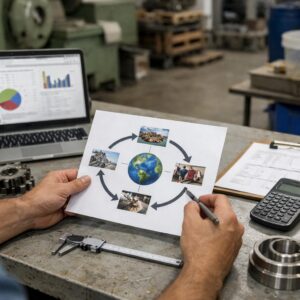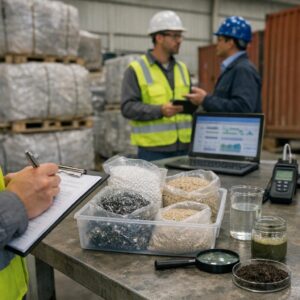
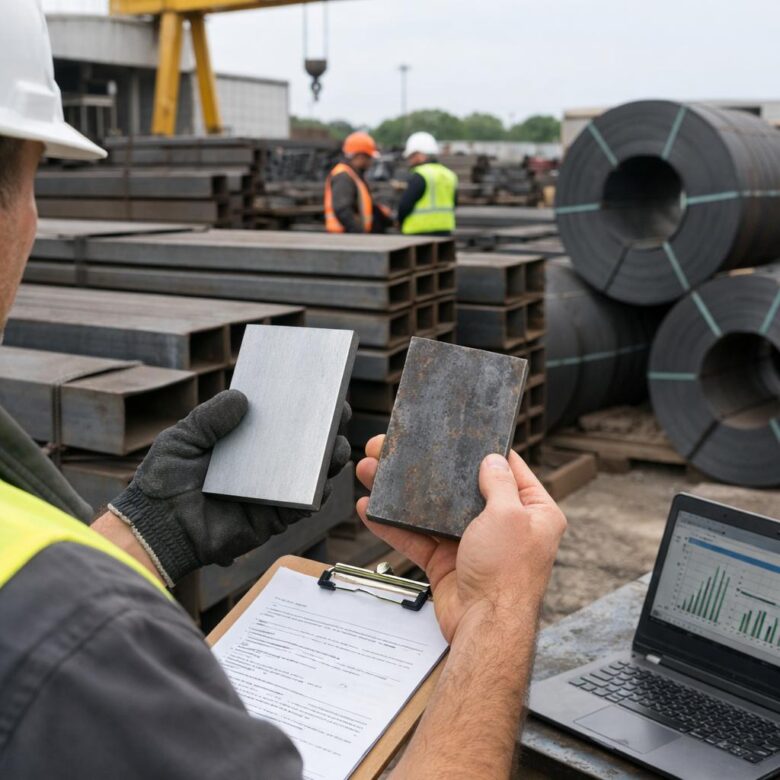
Sourcing lower-emission steel for a large industrial project requires more than accepting a “green steel” label. The material must satisfy structural specifications, fabrication requirements, delivery schedules and quality controls while its environmental claim remains measurable, comparable and connected to the steel that is actually supplied.
Steel can represent a substantial share of the material used in factories, warehouses, energy facilities, pipe racks, equipment platforms, bridges, foundations, towers, frames and other industrial structures. Because these projects may purchase thousands of tonnes across several packages, procurement decisions can influence both embodied carbon and construction risk.
The difficult part is that “low-carbon steel” is not one universally defined grade or manufacturing route. One supplier may be describing high recycled content, another may be referring to renewable electricity, and another may be selling a certificate linked to emissions reductions that are not physically traced through the delivered batch.
A reliable sourcing strategy therefore begins with a project-specific definition, technically equivalent comparisons and documentation requirements that continue from the steel mill through the distributor, fabricator and construction site.
Central procurement rule: technical compliance should be a pass-or-fail requirement. Carbon performance should only be compared among products that already meet the required grade, mechanical properties, dimensions, welding procedures, coating system, inspection requirements and applicable construction standards.
Clarify What “Low-Carbon Steel” Means
Lower-Emission Steel Procurement
In sustainability and construction procurement, the term generally refers to steel produced with lower greenhouse gas emissions than an appropriate conventional or market reference for an equivalent steel product.
The claim may relate to the manufacturing route, energy source, raw materials, process improvements, verified emissions intensity or a recognized certification and chain-of-custody system.
Low-Carbon Metallurgical Steel
In metallurgy, “low-carbon steel” may describe steel with a relatively low percentage of carbon in its chemical composition.
That definition concerns material properties and is not the same as a product having low greenhouse gas emissions. Procurement documents should avoid confusing the two meanings.
Do not request “low-carbon steel” without defining the intended meaning. A supplier may provide a technically valid low-carbon-content grade while offering no evidence that the production process has a lower greenhouse gas footprint.
Define the Project Requirement Before Contacting Mills
A sourcing team needs a measurable requirement that matches the project’s product categories and reporting method. A general corporate emissions target is not detailed enough for a steel tender.
Questions to Resolve Internally
- Which steel packages have the greatest material quantity?
- Which components are structural or safety-critical?
- Which products are technically interchangeable?
- What environmental declaration format will be accepted?
- Which life cycle modules must be reported?
- Will project transport and fabrication be included?
- Is there a maximum embodied-carbon threshold?
- Will industry-average EPDs be accepted?
- Is facility-specific information required?
- Are mass-balance or certificate-based claims permitted?
- Who approves technical and carbon documentation?
- What happens if the proposed mill becomes unavailable?
A threshold should be tied to the correct product and unit. A value for one tonne of reinforcing bar should not automatically be applied to structural plate, hollow sections or finished fabricated assemblies.
Understand the Main Steel Production Routes
Production route can help explain why emissions differ, but it should not replace product-specific data. Electricity source, ore quality, scrap quality, alloy content, fuel, plant efficiency, yield and downstream processing can all change the result.
Blast Furnace and Basic Oxygen Furnace
This route primarily converts iron ore into iron and steel using carbon-containing reducing agents. Improvements may include energy efficiency, alternative fuels, material optimization and carbon-capture projects.
Procurement caution: a company-wide transition plan does not establish the emissions intensity of the specific product and facility offered to the project.
Electric Arc Furnace
Electric arc furnaces can use high proportions of steel scrap and electricity rather than producing all iron from ore. Their footprint can vary with electricity generation, scrap processing, yield, alloy additions and product requirements.
Procurement caution: an EAF label alone does not prove that every product has the lowest available embodied carbon.
Direct Reduced Iron and EAF
Direct reduced iron can provide an iron source for electric-furnace steelmaking. Emissions depend on the reducing agent, electricity, ore preparation, transport and plant configuration.
Procurement caution: gas-based, hydrogen-supported and other DRI pathways should be evaluated using verified data for the actual operating plant.
Mass Balance and Certificates
Some suppliers allocate verified emissions reductions to selected steel products through accounting or chain-of-custody systems rather than physically separating every tonne.
Procurement caution: buyers must understand whether a claim represents physical product traceability, mass balance, book-and-claim or an unbundled certificate.
Do not count the same emissions reduction twice. When certificates, renewable-energy attributes, mass-balance claims or separately allocated reductions are involved, confirm whether the product footprint already includes the benefit and whether the project’s reporting framework permits the claim.
Request an Evidence Package, Not a Marketing Brochure
A strong supplier submission should connect the environmental information to the actual product, production site and order. Environmental evidence and technical quality documents serve different purposes and both are necessary.
| Document | What It Should Confirm | What to Check Carefully |
|---|---|---|
| Environmental Product Declaration | Environmental impacts | Product, plant, declared unit, system boundary, validity, verifier and product category rules |
| Product carbon footprint | GHG intensity | Methodology, included scopes, data year, allocation, electricity treatment and verification |
| Mill test certificate | Technical properties | Heat number, grade, chemistry, mechanical results and applicable specification |
| Production-site certificate | Site assurance | Certified facility, standard version, certification level, validity and scope |
| Chain-of-custody evidence | Claim transfer | Physical segregation, controlled mixing, mass balance, certificate ownership and retirement |
| Delivery and traceability record | Order linkage | Purchase order, batch, heat, distributor, fabricator, quantity, delivery and substitution history |
An EPD is not a structural certificate or an automatic environmental endorsement. It reports environmental information under stated rules. The project team must still verify product suitability and determine whether declarations are sufficiently comparable.
How to Compare Environmental Product Declarations
Two EPDs can display greenhouse gas values that look comparable while using different assumptions. Procurement teams should review the declaration details before ranking suppliers.
| Comparison Point | Why It Matters | Preferred Practice |
|---|---|---|
| Declared unit | Values may be stated per kilogram, tonne or another unit | Convert all options to the same correctly defined unit |
| Product category | Different steel forms can require different processing | Compare technically equivalent products |
| Life cycle boundary | One result may cover only production while another includes more stages | Compare matching modules, commonly A1–A3 for mill-level procurement |
| Product specificity | Industry averages may hide large differences between mills | Prefer product- and facility-specific data when available and required |
| Manufacturing location | Grid electricity, fuels and production route vary by site | Confirm the plant that will supply the order |
| Validity and data year | An old declaration may not represent current production | Check publication, expiry, data period and recent process changes |
| Allocation and recycling method | Different rules can change reported burdens and credits | Use consistent methods or clearly disclose differences |
| Verification | Independent review improves confidence in the declaration process | Confirm the programme operator and verifier |
Digital EPD databases can simplify screening, but they do not remove professional judgment. Tools such as EC3 can help organize declarations and compare upfront embodied carbon, while the project team remains responsible for technical equivalence, scope and final approval.
Use a Controlled Procurement Workflow
-
Map the bill of materials by steel package.
Separate beams, columns, plate, rebar, sections, piping, supports, secondary framing and other products by grade, quantity, dimension and required delivery phase. -
Identify technical non-negotiables.
Confirm structural design, code, toughness, fatigue, chemistry, weldability, forming, bolting, coatings, corrosion, fire protection, tolerances and inspection requirements. -
Establish the carbon accounting method.
Define the accepted indicator, declared unit, life cycle modules, baseline, product category, data quality and rules for certificates or mass balance. -
Engage suppliers before the design is frozen.
Ask mills, service centers and fabricators which lower-emission options are available in the required grades, dimensions, volumes and delivery windows. -
Issue one standardized supplier questionnaire.
Require every bidder to answer the same questions about plant location, production route, EPD, verification, traceability, recycled input, energy sourcing and order allocation. -
Apply the technical compliance gate first.
Reject or clarify products that do not meet engineering, fabrication, inspection and code requirements before comparing their carbon performance. -
Normalize the environmental data.
Convert submissions to the same unit and boundary. Document material differences that prevent a direct comparison. -
Evaluate fabrication and logistics.
Include cutting yield, offcuts, rework, coating, welding, transport distance, handling, delivery route and potential schedule effects. -
Write evidence requirements into the contract.
State the required documents, approval process, substitution restrictions, traceability records, delivery checks and consequences of noncompliance. -
Verify the supplied material before final acceptance.
Match delivery records, mill certificates, environmental declarations, heat numbers, quantities and approved suppliers before the steel is permanently incorporated.
Use Decision Gates Instead of One Vague Score
Technical Gate
Pass or fail based on grade, dimensions, structural requirements, testing, weldability, fabrication and applicable codes.
Evidence Gate
Pass, clarify or reject based on EPD quality, product scope, verification, plant identity, methodology and traceability.
Commercial Ranking
Compare technically acceptable suppliers by embodied carbon, total cost, delivery, capacity, logistics and supply risk.
Questions to Send to Every Supplier
- Which mill and production line will supply the order?
- Which production route is used for the offered product?
- Is the environmental result product-specific or an industry average?
- Which life cycle modules are included?
- What is the declared unit?
- Which year does the production data represent?
- Who independently verified the declaration?
- Does the EPD cover the exact product and facility?
- Is the claim physically traced, mass-balanced or certificate-based?
- How is double counting prevented?
- Can batch or heat-level traceability be maintained?
- Are technical mill certificates supplied with every delivery?
- What quantity is contractually available?
- What are the minimum order and production lead time?
- Can the fabricator maintain separation and traceability?
- What substitutions are permitted during supply disruption?
Protect the Requirement in the Contract
Contract Controls Worth Including
- The environmental documentation required before material approval
- The approved steel product, grade, mill and production site
- The accepted EPD, carbon-footprint or certification methodology
- The required declared unit and life cycle boundary
- The maximum permitted carbon value where the project uses a threshold
- Rules for physical, mass-balance and certificate-based claims
- Evidence that certificates are uniquely assigned or retired
- Written approval before any mill, grade, product or claim substitution
- Traceability obligations for distributors and fabricators
- Documentation required with each shipment and final handover
- Rights to audit or request clarification of supporting records
- Remedies when the delivered product does not match the approved submission
The procurement specification should not allow a lower price, delivery delay or distributor change to automatically override the embodied-carbon requirement. The process for approving substitutions should be established before construction pressure begins.
Track the Material Through the Fabricator
The fabricator may purchase, cut, drill, weld, coat and assemble steel from several sources. Even when the mill submission is strong, project traceability can be lost if batches are mixed or records do not follow the material into finished assemblies.
| Fabrication Control | Why It Matters | Useful Evidence |
|---|---|---|
| Receiving inspection | Confirms that delivered steel matches the approved order | Delivery ticket, heat number, marking, quantity and mill certificate |
| Material identification | Prevents mixing with unapproved steel | Tags, controlled storage, digital records and cutting-plan linkage |
| Cutting and nesting | Reduces avoidable offcuts and additional purchasing | Nesting records, yield report and offcut reuse plan |
| Substitution control | Prevents schedule-driven changes from bypassing approval | Formal request, engineering review and carbon-data comparison |
| Assembly traceability | Connects finished members to approved material sources | Shop drawings, piece marks, batch records and fabrication database |
| Handover package | Supports final carbon reporting and quality records | Final quantities, declarations, certificates, substitutions and waste data |
Material efficiency remains important even when the steel has a low emissions intensity. Structural optimization, standard section selection, efficient nesting, reuse of offcuts and prevention of rework can reduce the total tonnage purchased.
Include Logistics Without Losing Perspective
Transport can influence the project-level footprint, especially for heavy steel moved over long distances or through several handling points. However, the nearest supplier is not automatically the lowest-emission option, and the mill with the lowest production value is not automatically the best total project option.
Compare the complete supply route consistently:
- Mill to service center distance
- Service center to fabricator distance
- Fabricator to coating facility distance
- Final transport to the construction site
- Road, rail, inland waterway or ocean transport
- Vehicle utilization and return trips
- Extra handling and temporary storage
- Oversize-load and route restrictions
- Packaging and corrosion protection
- Material damage and replacement risk
Do not add transport to one supplier while comparing it with another supplier’s factory-only figure. Apply the same project boundary and logistics assumptions to every option.
Common Greenwashing and Procurement Red Flags
| Red Flag | Why It Is a Problem | Better Requirement |
|---|---|---|
| “Green,” “clean” or “carbon-free” with no method | The claim has no measurable boundary or comparison basis | Request verified product-level greenhouse gas data |
| Only a company sustainability report | Corporate averages may not represent the supplied product | Request product and manufacturing-site documentation |
| Recycled content presented as the complete carbon result | Electricity, yield, alloying and processing are omitted | Compare full declared embodied-carbon data |
| EPD for a different plant or product | The document may not cover the proposed order | Require a clearly applicable declaration |
| Certificate with unclear ownership | The same reduction may be sold or reported more than once | Require unique assignment, retirement and audit records |
| Different life cycle boundaries | One supplier may appear better because fewer processes were included | Normalize the comparison or disclose incompatibility |
| Unrestricted substitution clause | Approved steel can be replaced without carbon review | Require written technical and sustainability approval |
| Unconfirmed production capacity | Low-carbon material may not arrive when construction needs it | Obtain written volume allocation and delivery commitments |
Balance Carbon, Cost and Schedule
A large project may not be able to source every steel product from the same lower-emission route. Availability can differ between rebar, plate, sections, pipes, specialty grades and heavy fabricated components.
A practical strategy is to prioritize high-volume packages with credible alternatives while protecting critical-path structural components from unacceptable supply risk. The project can then document why specific packages achieved stronger reductions than others.
| Project Situation | Practical Strategy | Primary Risk to Control |
|---|---|---|
| High-volume common sections | Engage several mills early and set a measurable emissions threshold | Production allocation and delivery consistency |
| Specialty structural grade | Use technical availability as the first gate and compare verified alternatives | Grade equivalence and fabrication qualification |
| Schedule-critical package | Preapprove backup mills with equivalent technical and carbon evidence | Late unreviewed substitution |
| Long-distance imported steel | Compare production and logistics using one project boundary | Transport, customs, handling and schedule uncertainty |
| Public carbon commitment | Use verified documentation, controlled claims and independent review | Greenwashing and double counting |
When Professional Review Is Essential
Structural engineers, materials specialists, welding engineers, quality professionals, procurement teams, fabricators and life cycle assessment specialists should be involved when the steel is safety-critical, highly loaded, fatigue-sensitive, exposed to severe corrosion, subject to unusual temperatures or covered by strict public carbon requirements.
Environmental claims may also require specialist review when suppliers use different product category rules, recycling methods, electricity instruments, chain-of-custody systems, mass balance or emissions-reduction certificates.
Never approve a structural substitution from carbon information alone. Changes in grade, chemistry, thickness, toughness, welding behavior, coating, heat treatment or manufacturing route may affect design, fabrication, inspection and long-term performance.
Final Recommendation
Effective low-emission steel sourcing begins during design and tender planning, not after the purchase order is ready. The project team should map steel demand, establish technical pass-or-fail criteria and define exactly what environmental evidence will be accepted.
Supplier comparisons should use equivalent products, declared units and life cycle boundaries. An EPD, product carbon footprint, mill test certificate and chain-of-custody record answer different questions and should be reviewed together.
The contract should protect the approved mill, product, carbon claim and documentation route while requiring review before substitutions. The fabricator should preserve identification and traceability through cutting, welding, coating and final delivery.
The strongest procurement decision is not necessarily the steel with the lowest isolated emissions number. It is the technically compliant option that delivers credible carbon reduction, documented traceability, manageable cost, reliable volume and an achievable construction schedule.
Frequently Asked Questions
Is electric arc furnace steel always lower carbon?
No. Electric arc furnace production can offer lower emissions in many situations, particularly when it uses suitable scrap and lower-emission electricity. The result still depends on the electricity source, scrap preparation, alloy content, yield, processing and the exact product being supplied.
Is high recycled content enough to prove a low-carbon claim?
No. Recycled content is useful information, but it does not include every source of emissions. Buyers should also review electricity, fuels, raw materials, process efficiency, alloying, yield and product-specific environmental data.
What is the most important document to request?
No single document is sufficient. An EPD or verified product footprint supports the environmental comparison, while mill test certificates confirm grade and properties. Traceability records connect those documents to the delivered order.
Can industry-average EPDs be used?
They may be useful for early design estimates or when product-specific declarations are unavailable. They are less precise for supplier selection because individual mills can perform differently. The project should state whether average declarations are acceptable.
What is the difference between physical traceability and book-and-claim?
Physical traceability follows certified or attributed material through the supply chain. Book-and-claim separates the environmental attribute from the physical product and transfers it through an accounting system. The project must understand which claim is being purchased and whether its reporting rules permit that approach.
Should transport emissions be included?
They should be considered when the project compares total delivered options or reports construction-stage impacts. Apply the same transport boundary, distance method and assumptions to all suppliers.
Can lower-emission steel be used structurally?
Yes, provided the exact steel meets the required grade, mechanical properties, dimensions, welding requirements, inspection criteria and applicable structural standards. The environmental profile does not replace engineering approval.
How can a project prevent substitutions from weakening its target?
Name the approved documentation, product and mill in procurement records, require written approval before substitutions and preserve traceability through the distributor and fabricator. Backup suppliers should be evaluated before schedule pressure occurs.
Does ResponsibleSteel certification prove the exact product is low carbon?
Certification scope must be reviewed carefully. Site-level responsible-production certification, progress levels and downstream product claims are not automatically identical. Confirm the current standard version, certified facility, claim type and chain-of-custody evidence that applies to the offered product.
Official References and Procurement Tools
- ISO 14025 — Environmental Product Declarations
- ResponsibleSteel — International Production Standard and Certification
- World Steel Association — GHG Accounting and Chain-of-Custody Guidance
- World Steel Association — Steel Life Cycle Assessment Methodologies
- Building Transparency — EC3 Embodied Carbon and EPD Tool

The Ogumex Editorial Team creates practical, research-based content about commercial solar energy, battery storage, clean technologies, and sustainable industrial solutions. Our goal is to explain complex topics clearly, helping professionals, businesses, and informed readers make better decisions. Each article is reviewed for clarity, accuracy, and usefulness using reliable industry and official sources.